Artiste
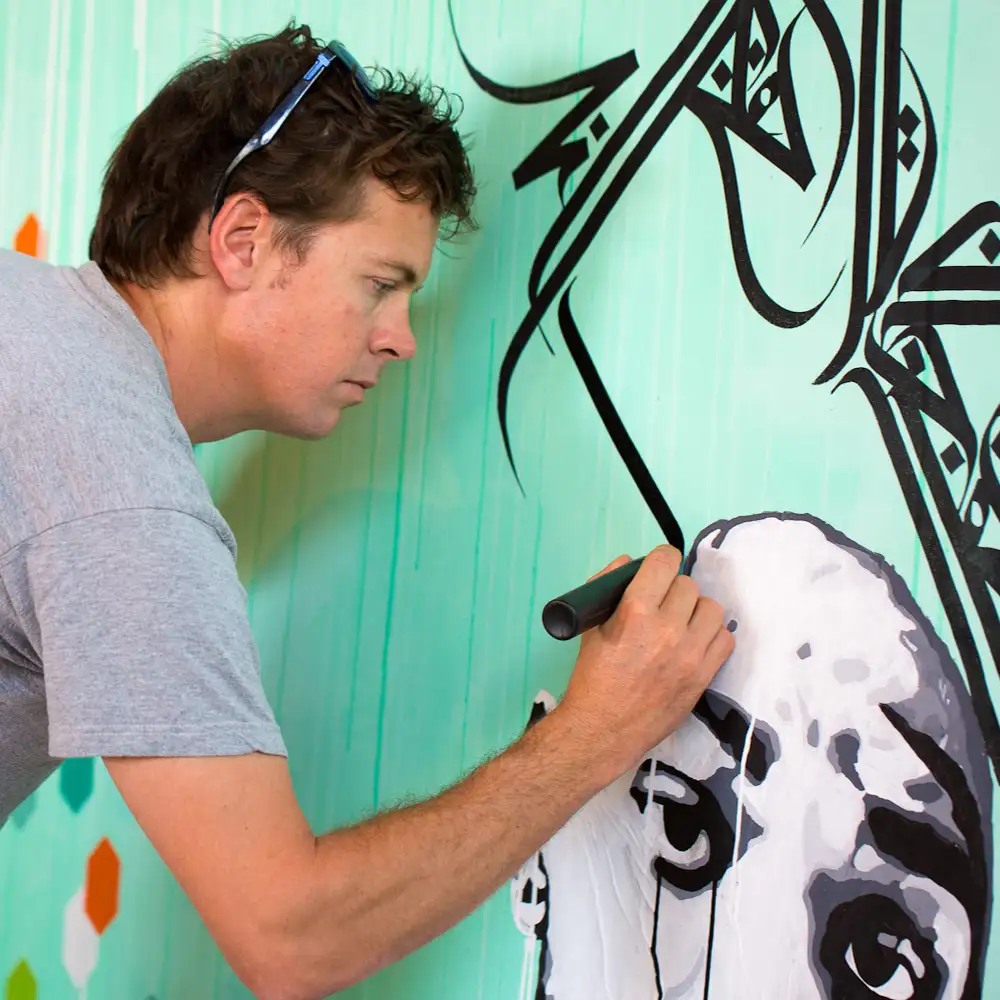
Yann Chatelin
Ville
Grenoble
Adresse
28 boulevard Général Gallieni, Grenoble 38100
À propos de l'œuvre
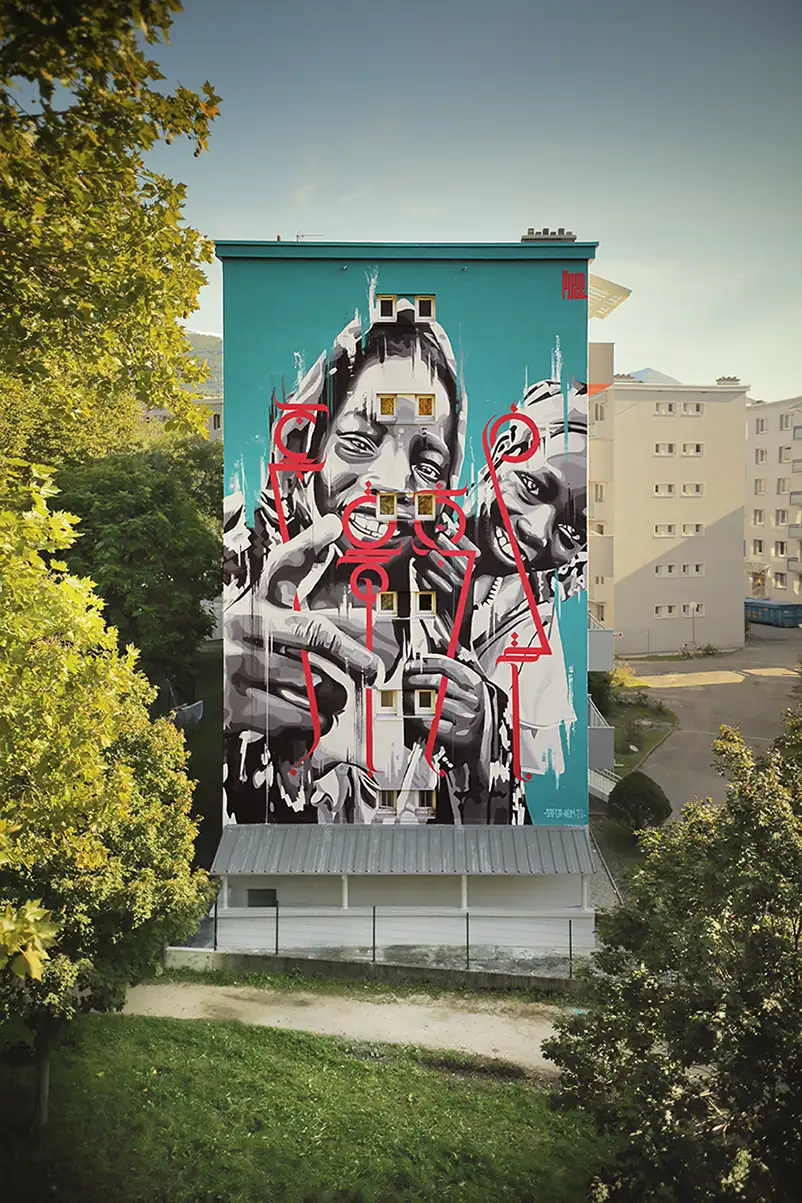
Pour Yann Chatelin : « Il y a deux lectures possibles pour cette fresque.
La première constitue le fil directeur de mon travail depuis environ trois ans. Il s’agit de prendre en compte le fait que l’écriture manuscrite disparaît progressivement du paysage contemporain. Avec elle s’efface également notre capacité à mémoriser, à nous orienter ou à développer une idée… On parle donc d’une perte de puissance des facultés humaines, voire d’une dévitalisation de l’homme (cf. Alain Damasio, Très humain plutôt que transhumain). Cela témoigne d’une transformation sociétale où l’être humain s’en remet toujours davantage à la machine. L’écriture, miroir de la personnalité, se standardise au contact des claviers, entraînant une perte de singularité individuelle.
Sur le mur, cette idée est illustrée par une dégradation volontaire des personnages (coulures, éclaboussures, effet de glitch) qui annonce les prémices de la disparition de l’humain. La dernière étape de création est la superposition de lettres sur les personnages. Celles-ci sont très soignées et d’une couleur qui interpelle, afin d’en accentuer l’importance. Ces lettres font partie d’un alphabet que j’ai créé et qui continue d’évoluer. Il s’inspire des courbes et ponctuations du sanskrit et de l’arabe, tout en se basant sur la structure des lettres latines. Il est donc possible de décoder ces lettres. Cependant, le fait qu’elles représentent une écriture universelle (ou le symbole de l’écriture) me semble plus important que le contenu du mot ou du message inscrit.
La deuxième lecture de l’œuvre s’attache aux modèles humains choisis.
Il s’agit ici d’une photo prise par Alexandre Dupeyron au sud du Tchad (Alex est un ami proche et je suis fasciné par son travail). Ce sont deux jeunes filles qui avaient fui la République centrafricaine avec leur famille et qui venaient d’obtenir l’asile politique au Tchad. C’était donc un moment de paix synonyme de nouveau départ. Cela permet d’aborder la notion de migration des peuples, à laquelle nous sommes et serons confrontés dans des proportions encore plus grandes ces prochaines années. Les généreux sourires de ces deux jeunes filles semblent remettre en question les politiques de fermeture des frontières, qui paraissent à la fois inhumaines et inefficaces. »
According to Yann Chatelin: “There are two possible readings of this mural.
The first constitutes the guiding thread of my work for the past three years. It involves acknowledging the fact that handwritten writing is gradually disappearing from the contemporary landscape. With it, our ability to memorise, orient ourselves, or develop an idea is also fading… We are therefore talking about a loss of power of human faculties, or even a devitalisation of man (cf. Alain Damasio, Très humain plutôt que transhumain). This reflects a societal transformation in which human beings are increasingly relying on machines. Writing, a mirror of personality, is becoming standardised through keyboards, leading to a loss of individual singularity.
On the wall, this idea is illustrated by a deliberate degradation of the characters (drips, splashes, glitch effect) announcing the beginnings of the disappearance of the human being. The final stage of creation is the superimposition of letters over the characters. These are very carefully executed and in a striking colour to emphasise their importance. These letters are part of an alphabet I created that continues to evolve. It draws inspiration from the curves and punctuation of Sanskrit and Arabic, while being based on the structure of Latin letters. It is therefore possible to decode these letters. However, the fact that they represent a universal form of writing (or the symbol of writing itself) seems more important to me than the content of the word or message written.
The second reading of the work focuses on the human models chosen.
It is a photo taken by Alexandre Dupeyron in southern Chad (Alex is a close friend and I am fascinated by his work). These are two young girls who had fled the Central African Republic with their family and had just been granted political asylum in Chad. It was therefore a moment of peace, synonymous with a new beginning. This allows us to address the notion of people’s migration, which we are and will be confronted with in even greater proportions in the coming years. The generous smiles of these two young girls seem to call into question border closure policies, which appear both inhumane and ineffective.”
Timelapse